
Best High Protein Wet Dog Food for Labrador Puppies
Introduction
While discussing dog breeds with a friend recently, he told me about his Labrador puppy. He shared that the qualities of this breed are exceptional, noting they are very loyal to their owners. Another great quality is their intelligence; if you train a Lab, they remember everything and follow instructions well. They are a very child-friendly breed, considered a perfect family dog, and are very easy to train.
However, Labradors are very fond of eating just about anything, even things that may not be good for their health. To get food, they are willing to do almost anything. Being a Labrador owner, it is your responsibility to take care of your Lab’s diet and their specific needs. The most important task is to provide the best and most appropriate food for your Lab.
As my friend’s reviews mentioned, Labradors love eating with hearty appetites. An appropriate diet leads to a healthy life because if they do not have a good diet, they may face issues like allergies and weight problems. If your puppy is already struggling with digestion, you can read my research on how to manage sensitive stomachs in Labradors.For this diet, meat plays a great role as it provides essential proteins. Oats, rice, and vegetables like potatoes and peas are also great options to include in their nutrition. But be careful—dogs of different ages need different food. For example, puppy Labs require fatty acids like Omega-3 and 6, which are found in herring oil. Mother’s milk is one of the most important nutrients helping in their brain development; another good option for strengthening the immunity of your Lab is to provide probiotics.
While high protein is essential for growth, some puppies may also experience digestive issues early on. If your Lab has a delicate tummy, be sure to check out my deep dive on The Best Food for Labradors with Sensitive Stomachs for specific digestive health tips.
Labrador Puppy Needs (Up to 12 Months)
A puppy of this age requires high-quality proteins to strengthen their muscles and support bone development. Do not give them too much fat, because overfeeding may cause health issues. A calcium and phosphorus ratio of 1:1.2 is a very suitable amount for them.
Because the Labrador breed is heavy and active compared to other dog breeds, look for wet foods containing Glucosamine and Chondroitin. These nutrients act as natural building blocks to keep their bones and joints strong and healthy as they grow.
Regarding the Labrador’s natural intelligence, DHA and EPA—found in rich sources such as salmon and herring oil—support your dog’s cognitive development to keep them sharp and active. These fatty acids also contain fats that enhance the brain and retina to keep them healthy.
The “Hungry Gene”: Scientific Insights
Scientifically, the POMC gene mutation has been identified in research on Labradors. This gene is the reason they are always motivated by food. It is a genetic trait that creates a constant feeling of hunger; on the other hand, it also slows down their metabolism. Because research shows many Labradors have this mutation, it explains why they are so food-motivated. To keep your dog healthy, always opt for a high-protein wet food with a normal amount of fat.
Tracking the Transformation
During my research for NeedBestOnline, I discovered that the first year of a Labrador’s life is a high-speed transformation. Between 2 and 12 months, these puppies go through a massive growth spurt, sometimes gaining up to 2 pounds per week! While it is exciting to watch them grow, this rapid development is a delicate balance. If a Labrador puppy grows too fast, their heavy muscles can put dangerous pressure on their young, soft bones. This is why understanding the “Large Breed” growth curve is so important—it’s about ensuring their skeleton can safely support their weight as they mature.
Labrador Puppy Growth Stages: 2 to 12 Months
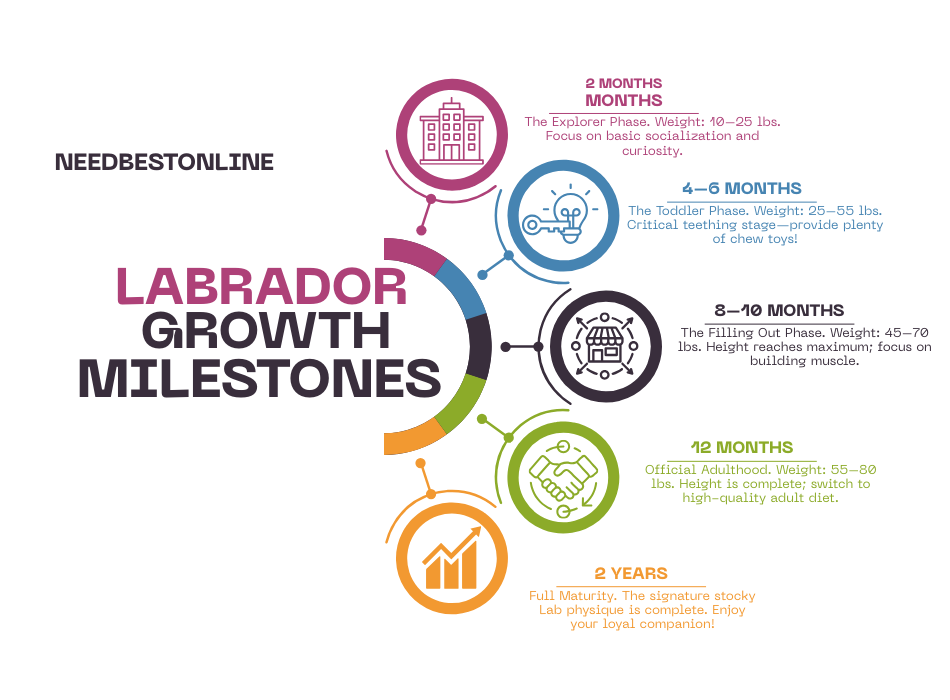
Researching on needbestonline.com as a pet Labrador owner myself, I discovered that while a puppy is born at a small weight, they reach 10–25 lbs by 2 months and 55–80 lbs by 12 months.
-
- The Explorer Phase (2–3 Months): We can call this the “explorer phase.” They are very small during this time—I noticed with my own puppy that the weight is approximately between 10 and 25 lbs. They are very sensible at this age due to their sharp “sense of humor” and curiosity. According to my research, this is the best time to begin basic socialization.
-
- The Toddler Phase (4 Months): They are no longer just little puppies; with a weight between 25 and 40 lbs, they are starting to look like mature dogs. This is a critical time because their adult teeth are developing, and the discomfort compels them to chew on anything they find. Providing chew toys is the best option here.
-
- Adolescence (6 Months): My research analysis proves that during this time, a puppy’s weight typically remains between 35 and 55 lbs. Puppies at this stage often show high energy levels, much like human teenagers do.
-
- The Filling Out Phase (8–9 Months): In this stage, their height reaches its maximum level, while their muscles become stronger and more coordinated. Weight reaches approximately 45 to 65 lbs. This is the transition from a puppy to a dog.
-
- Adulthood (12 Months): Labradors officially become adults. Most reach their full height, standing between 21 and 23 inches at the shoulder. In my case, I noticed my male Lab gained a solid weight between 55 and 80 lbs. While they may still fill out over the next six months, their skeletal growth is nearly complete.
Our Top-Researched High-Protein Wet Food Recommendations
Being a researcher, I always prefer to look at the ingredients a product contains rather than just the brand name. For the development of a Labrador puppy’s brain and bones, I always recommend looking for the best products that provide those specific nutritional requirements. Focus on finding high-quality protein and essential fatty acids like DHA to ensure your puppy grows up strong and healthy.
Royal Canin Labrador Retriever Puppy
For the best consistent growth, this product is formulated specifically for your breed.
-
- The Science: It uses L.I.P. proteins and prebiotics (FOS) and can be used for up to 15 months. This helps to support the sensitive digestive systems of your puppies.
-
- Bone Health: To prevent your puppy’s bones from growing too fast, it contains adapted levels of phosphorus and calcium which provide the necessary strength for their joints.
-
- Researcher’s Note: This product is designed with a “donut-shaped” kibble, which encourages fast-eating Labs to slow down and actually chew.
Wellness CORE Grain-Free Puppy
As the name specifies, this formula contains a high-meat diet, and different nutrients are offered by this formulation.
-
- The Science: For lean muscle support, it has 49% high-quality protein ingredients (Chicken and Turkey).
-
- Brain Support: To boost natural intelligence, it functions like fuel; it contains guaranteed DHA from salmon oil.
-
- Researcher’s Note: It is a grain-free product and the best choice for puppies that may show early signs of skin or stomach sensitivities.
Hill’s Science Diet Puppy: Chicken & Barley Stew
This is a great example of a “transitional” food for puppies moving into the Adolescence Phase.
-
- The Science: It contains DHA from fish oil for healthy eye and brain development, while balanced minerals help keep teeth and bones strong.
-
- Texture: With high moisture, it helps stimulate the kidneys in order to manage hydration during active months.
-
- Researcher’s Note: This is an excellent choice for Labs that are highly food-motivated but need a lower-calorie “filler” to stay at a healthy weight.
Nutritional Comparison Table
| Nutritional Feature | Royal Canin (Breed Specific) | Wellness CORE (Grain-Free) | Hill’s Science Diet (Stew) |
| Primary Protein | L.I.P. Poultry | Chicken & Turkey | Chicken |
| DHA Source | Fish Oil | Salmon Oil | Fish Oil |
| Target Age | Up to 15 Months | Puppy Growth | Under 1 Year |
| Special Focus | Bone & Joint | High Protein (49%) | Brain & Eye Health |
Researcher’s FAQ
-
- How big should a 6-month-old Labrador Retriever be?
- Typically between 35 and 55 lbs (around 16–25 kg). Males are usually heavier (40–55 lbs) than females (35–45 lbs). My Lab gained a consistent 2 lbs per week during this time.
-
- At what age is a Labrador Retriever fully grown?
- They are generally full-grown in height by 12 months, but they continue to “fill out” and build muscle mass until they are 18 months to 2 years old.
-
- How to tell how big a Lab puppy will get? Check your Lab’s weight at 4 months and multiply by 2. Based on my study of growth charts, most will reach between 55 and 80 lbs.
Conclusion
Watching a Labrador grow is a truly exciting experience. As a researcher and a Lab owner, I’ve found that the real joy comes from how much they change during each phase—there is always something new to do and a new need to fulfill. With patience and the best nutrition, your Lab will grow from a tiny explorer into a strong, loyal companion.